
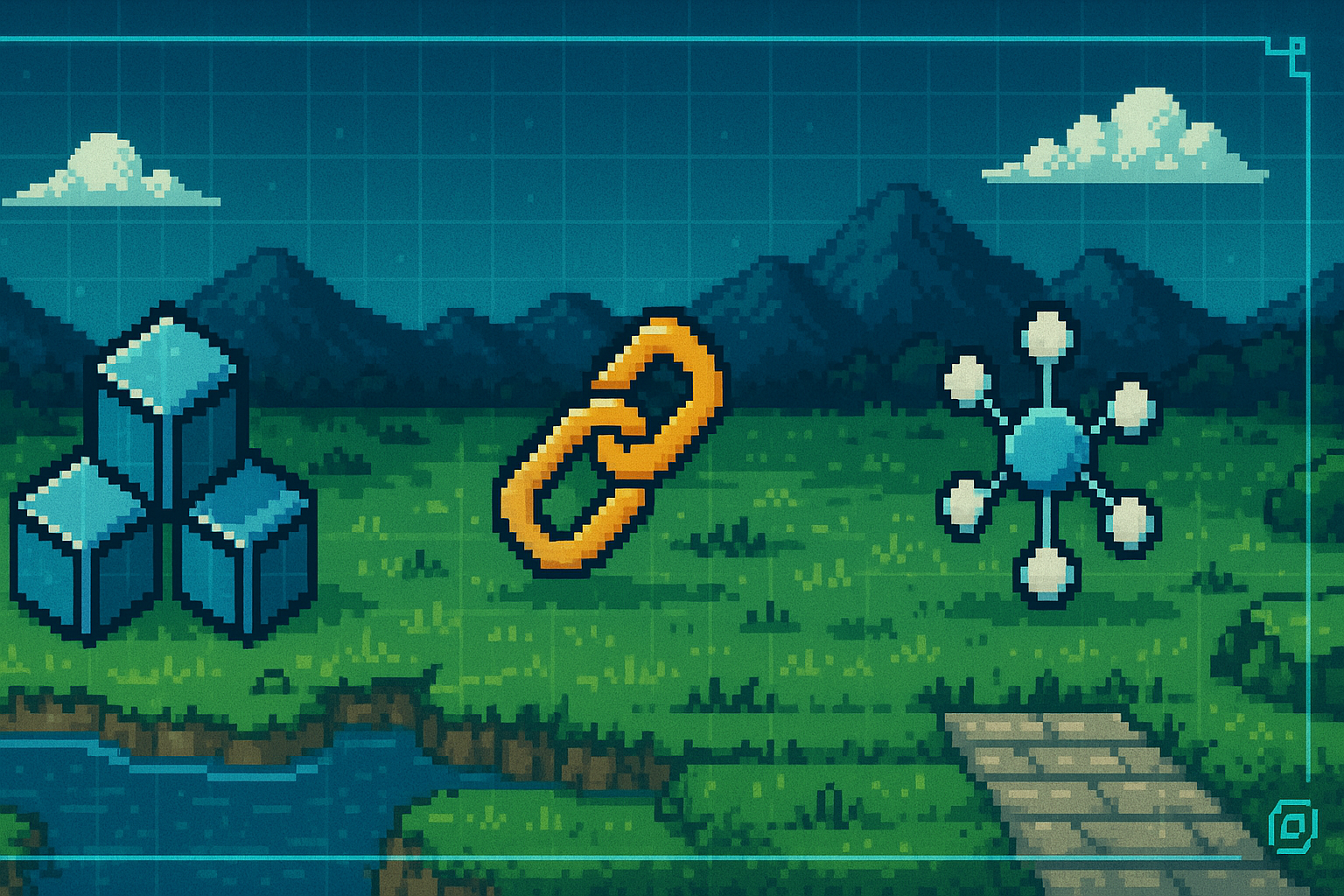

What Is a Blockchain?
A blockchain is a decentralized database maintained by many computers instead of a single authority.
Its goal is to provide trustless verification — meaning users don’t need to trust a bank, government, or company to confirm that transactions happened.
The foundational idea was introduced with Bitcoin in 2009 (Bitcoin whitepaper).
Since then, blockchains like Ethereum have expanded the concept to programmable applications (Ethereum docs).
But not every problem needs a blockchain — and understanding where it does make sense is key to learning crypto.
What Problem Does Blockchain Actually Solve?
At a high level, blockchain solves coordination without trust.
It is valuable when multiple participants need to maintain a shared database without relying on a middleman to update it.
Blockchains excel at:
- Preventing double-spending
- Ensuring data integrity
- Providing transparent, tamper-resistant records
- Creating digital assets with provable ownership
- Enabling global settlement without intermediaries
A BIS report frames blockchain’s purpose as ensuring “verifiable state transitions in a decentralized system” (BIS paper).
This sounds technical, but for beginners, the idea is simple:
Blockchain replaces the trust in institutions with math + consensus.
When Blockchain Makes Sense
Not every use case benefits from decentralization — but some require it.
1. Money and Payments
Bitcoin uses blockchain to enforce scarcity and prevent double-spending.
Stablecoins use blockchain for fast, global, programmable dollars.
2. Smart Contracts
Ethereum introduced the concept of self-executing code on a decentralized network (Ethereum documentation).
This allows for:
- Decentralized exchanges (Uniswap)
- Lending markets (Aave)
- On-chain governance (DAOs)
3. Digital Ownership (NFTs)
NFTs represent unique digital items whose ownership is public and verifiable.
Brands, artists, and game developers increasingly use them as persistent digital identity or asset layers (The Block NFT data).
4. Settlement + Recordkeeping
Blockchains shine when transactions must be publicly verifiable:
- Supply chain provenance
- Tokenized real-world assets (RWAs)
- Corporate governance votes
- Cross-border financial settlement
JP Morgan’s JPM Coin and Onyx settlement system both use blockchain-like infrastructure for institutional money movement (JPM Onyx).
5. Decentralized Coordination
Blockchains enable global communities to coordinate:
- DAO treasuries
- Shared funding pools
- Permissionless marketplaces
The blockchain removes the need for a centralized operator who could censor or mismanage funds.
What Blockchain Does Not Solve
This is where many beginners (and many startups) get misled.
Blockchain is not a magic wand.
Blockchain is not useful for:
- High-performance databases
- Private corporate data storage
- Everyday consumer apps
- Use cases where a trusted third party already works well
- Real-time, high-throughput computation
- Replacing all banks or governments
A widely cited MIT paper debunks many exaggerated blockchain claims, noting that most business use cases don’t benefit from decentralization (MIT Sloan Review).
Key limitations beginners should understand:
1. Scalability limits
Blockchains are slower than centralized systems because thousands of nodes must verify data.
Ethereum is improving throughput with Layer 2 scaling (Ethereum rollups), but it still can’t match a centralized database.
2. Costs
Blockchains require transaction fees (gas).
This cost is what protects the system from spam — but it also limits some use cases.
3. UX friction
Private keys, wallets, and self-custody are powerful but unfamiliar for beginners.
4. Data privacy
Most blockchains are public ledgers — not ideal for sensitive information.
5. Governance challenges
Decentralization slows decision-making and updates.
For many apps, this is a feature — not a bug — but it limits agility.
When Not to Use a Blockchain (Beginner Rules of Thumb)
Ask these four questions before deciding whether a blockchain is justified:
1. Do multiple parties need to share a database?
If not, you don’t need a blockchain.
2. Do those parties distrust each other?
If trust exists, a database is cheaper and faster.
3. Is censorship resistance or decentralization required?
If not, traditional systems may be sufficient.
4. Does the asset or data need to be globally verifiable?
If the answer is yes — blockchain shines.
Why Blockchains Still Matter in 2026
Despite the noise and hype cycles, blockchain continues advancing for two fundamental reasons:
1. It enables digital scarcity
This was impossible before Bitcoin.
2. It enables programmable, trust-minimized global settlement
This unlocks new markets, new institutions, and new economic coordination systems.
The combination of Bitcoin (digital money), Ethereum (programmable settlement), and stablecoins (digital dollars) forms the base layer of a new financial internet.
Crypto is not replacing banks — it’s creating parallel rails that are:
- Open
- Global
- Transparent
- Interoperable
- User-controlled
The Bottom Line (Beginner Summary)
Blockchain is a tool — not the solution to every problem.
It solves trust, ownership, and settlement in open networks.
It does not solve performance, privacy, or convenience.
Understanding this distinction helps beginners separate real innovation from hype.
Let’s Connect:
Follow us on X: https://x.com/OnchainNewsBlog
Join our Telegram channel: https://t.me/onchainnewsblog
Subscribe to our newsletter: https://onchainnews.blog/newsletter-alpha/
Disclaimer
The information provided in this article is for informational and educational purposes only and should not be construed as financial, investment, or trading advice. Onchain News does not provide recommendations to buy, sell, or hold any asset, and nothing here should be taken as a guarantee of future performance. Always conduct your own research and consult a qualified financial professional before making any investment decisions. Cryptocurrency markets are volatile and you are responsible for your own risk.


Leave a Reply