
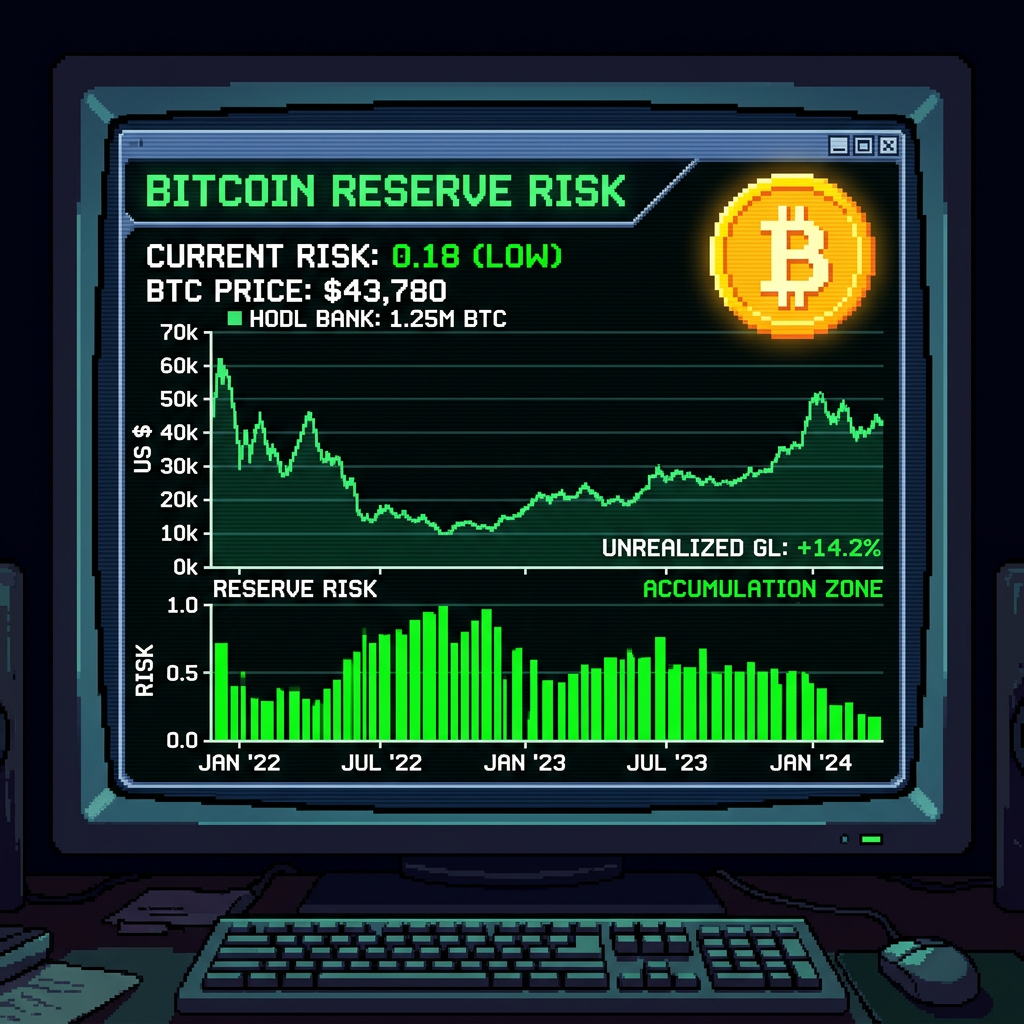
Reserve Risk is one of the most underrated onchain metrics in Bitcoin analysis. While most traders focus on price action and most analysts focus on popular metrics like MVRV Z-Score or exchange reserves, Reserve Risk quietly tells a deeper story: are long-term holders still convinced enough to keep holding, or are they starting to take profits?
Understanding Reserve Risk means understanding Bitcoin holder psychology at a structural level. This is the metric that rewards patience and punishes short-termism.
What Is Reserve Risk?
Reserve Risk is a ratio that compares Bitcoin’s current price against the cumulative opportunity cost of long-term holders. It answers a specific question: given how much patience long-term holders have demonstrated by not selling, is the current price adequately compensating them for that risk?
Reserve Risk = Current Price / HODL Bank
The HODL Bank is the accumulated opportunity cost of every long-term holder who chose not to sell. Every day a long-term holder keeps their coins off the market, they are giving up the option to sell at the current price. That foregone selling pressure accumulates into what is called the HODL Bank.
When the HODL Bank is high and price is low, Reserve Risk stays suppressed. Long-term holders have exercised enormous patience, but price has not moved high enough yet to compensate them. That combination historically signals deep value.
When price rises significantly while the HODL Bank is low, Reserve Risk spikes. Long-term holders have been selling into the rally, depleting the bank, while price has moved sharply upward. That combination historically signals cycle tops.
The Three Zones That Matter
Reserve Risk operates in three distinct zones that have historically corresponded with specific points in the Bitcoin market cycle:
Green Zone (below 0.002): The accumulation zone. Reserve Risk here means long-term holders have held through significant pain, the HODL Bank is high, and price has not yet compensated them. Bitcoin has historically offered the best forward returns when Reserve Risk sits here. This zone appeared in 2015, 2018-19, and again in 2022-23.
Orange Zone (0.002 to 0.008): Mid-cycle territory. Price is rising and long-term holders are beginning to take some profits. Reserve Risk is elevated but not at danger levels. This is where most of a typical Bitcoin bull run unfolds.
Red Zone (above 0.008): Historically, every major Bitcoin cycle top has occurred when Reserve Risk crossed into the red zone. In late 2017, it hit this level just before Bitcoin peaked near $20K. In late 2021, it entered the red zone again before the $69K top. The red zone does not mean sell immediately, but it signals that the risk/reward is shifting against buyers structurally.
Why Long-Term Holder Patience Is the Key Input
Reserve Risk is fundamentally a measure of conviction. Long-term holders, generally defined as those who have held Bitcoin for more than 155 days, are the cohort that has historically been right about market direction. They accumulated through fear and held through volatility. They are not panic sellers.
When this cohort holds through a drawdown, two things happen simultaneously. First, the HODL Bank grows because their coins are aging without being spent. Second, there is less sell pressure in the market because these coins are not being offered for sale. Both dynamics are structurally bullish.
Reserve Risk captures this in a single number. A low reading means long-term holders have been patient for a long time, but price has not yet risen enough to reward that patience. Historically, that imbalance resolves upward.
Historical Readings at Key Bitcoin Cycle Moments
2018-19 Bear Market Bottom: Reserve Risk fell deep into the green zone as Bitcoin dropped from $20K to $3K. Long-term holders held through the entire collapse, accumulating HODL Bank while price fell. Bitcoin subsequently ran from $3K to $69K over the following three years.
Late 2021 Cycle Top: As Bitcoin approached $69K, Reserve Risk climbed into the red zone. Long-term holders were selling into the rally, depleting the HODL Bank, while price was elevated. The patient cohort’s conviction was fading at exactly the point where most retail investors were most confident. The top was in.
2022-23 Bear Market: Following the FTX collapse and Bitcoin’s drop to $16K, Reserve Risk fell back into the green zone. Long-term holders who had not sold at the top were holding through extreme loss. HODL Bank rebuilt. By early 2023, Reserve Risk was back at historically attractive levels. Bitcoin ran from $16K to $73K in the 16 months that followed.
Q1 2026: Bitcoin fell from $108K to $75K through the first quarter of 2026. Reserve Risk fell toward the floor of its green zone range. Long-term holders added to their positions through the drawdown. The Q1 2026 onchain review showed LTH supply reaching an all-time high while price was collapsing, exactly the structural setup that has preceded every major Bitcoin recovery.
How to Use Reserve Risk in Your Analysis
Reserve Risk works best as a positioning tool rather than a timing tool. It tells you whether structural conditions favor buyers or sellers at a given moment. It does not tell you exactly when the move will happen.
Confirm accumulation signals: When Reserve Risk is in the green zone, cross-reference it with other Bitcoin accumulation zone signals like MVRV Z-Score, exchange reserves, and Realized Price. Multi-metric confirmation strengthens the signal significantly.
Monitor the exit: Reserve Risk does not need to hit the red zone for you to start paying attention. Entering the orange zone while price is making new highs is worth noting. The question to ask: are long-term holders beginning to distribute? If HODL Bank is declining and price is rising, the answer may be yes.
Use it with RHODL Ratio: The RHODL Ratio and Reserve Risk are complementary metrics. Both measure the balance between patient, long-term capital and recent speculative capital. When both are suppressed simultaneously, the signal is historically among the strongest in onchain analysis.
Where Reserve Risk Sits Today
As of May 2026, Reserve Risk remains near its green zone floor. Bitcoin recovered from the Q1 2026 lows, but the HODL Bank built during that drawdown is still large relative to current price levels. Long-term holders did not capitulate. HODL Waves confirm that over 70% of supply has not moved in more than 12 months.
What this means structurally: long-term holders exercised significant patience through a 46% drawdown from the $108K all-time high. That patience accumulated in the HODL Bank. For Reserve Risk to reach the orange or red zone, price would need to rise substantially while the HODL Bank depletes. The HODL Bank is not depleting yet.
This is not a price prediction. Reserve Risk does not tell you when price will move or how high it will go. What it tells you is that the structural conditions remain consistent with early-to-mid cycle positioning, not late-cycle distribution.
Where to Track Reserve Risk
Glassnode: The most comprehensive Reserve Risk chart with full historical data and zone overlays. The basic chart is accessible on the free tier.
LookIntoBitcoin: Clean Reserve Risk chart with historical zone coloring. Free access. Good for quickly checking the current zone.
CryptoQuant: Offers Reserve Risk alongside complementary LTH metrics including HODL Waves and Realized Price on the same platform.
For a broader toolkit of free platforms, see the 2026 guide to free Bitcoin onchain tools.
The Bottom Line
Reserve Risk is built around a simple premise: when smart money has been patient for a long time and price has not yet rewarded that patience, the risk/reward favors buyers. When price has risen sharply and smart money has been selling into it, the risk/reward shifts against them.
Its track record at identifying favorable accumulation zones, specifically the 2019 bottom, the 2020 reset, and the 2022-23 bear market floor, is worth taking seriously.
Right now, it is saying what it said at those prior inflection points: the patient cohort is still patient, and the price has not yet compensated them for that patience.


Leave a Reply