
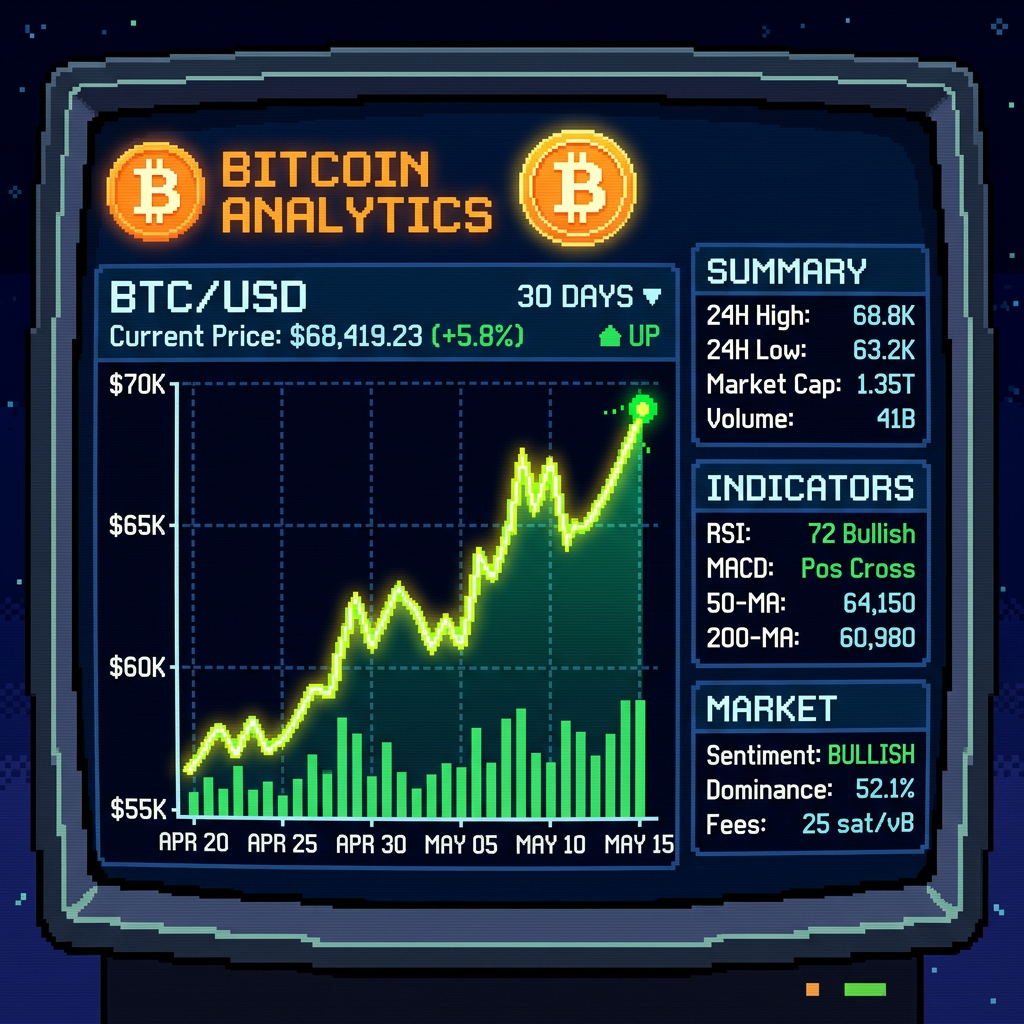
Bitcoin opened April 2026 with a hangover. Six consecutive red monthly closes. BTC near $65K. Fear and Greed stuck in extreme fear. The narrative on Crypto Twitter was split between “cycle top was $108K” and “dead cat bounce.” The onchain data was saying something different. Here’s what actually happened in April, metric by metric.
The Setup: What April Inherited from Q1
To understand April, you have to understand what Q1 2026 left behind. Bitcoin fell from $108K to a low near $65K between January and early April. That is a 40% drawdown from the all-time high. But the onchain structure through the entire selloff was telling a different story than price.
Long-term holder supply climbed to an all-time high through every week of Q1. Exchange reserves kept falling, now at their lowest level in nearly eight years. The cohort that has correctly called every cycle was not selling. They were accumulating. That context matters for reading what April’s data means.
Metric 1: STH-SOPR Flips Above 1.0 and Holds
STH-SOPR, the Spent Output Profit Ratio for short-term holders, spent the entire first quarter below 1.0. When STH-SOPR is below 1.0, short-term holders are realizing losses on average every time they transact. That is a capitulation signal. The longer it stays below 1.0, the more conviction builds on the other side.
In mid-April, STH-SOPR crossed back above 1.0 for the first time since Q4 2025. Then it held. Two weeks above 1.0 means short-term holders are now realizing gains again on average. Historically, this crossover, especially when it holds, has preceded expansion legs, not reversals. It is the shift from loss-realization pressure to cost-basis support. Worth watching whether it holds through May.
Metric 2: aSOPR Confirms the Shift
aSOPR, the adjusted SOPR which filters out same-day transactions to remove noise, also crossed above 1.0 for the first time since Q4 2025 during April’s recovery. This is the broader market equivalent of STH-SOPR crossing: it tells you that across all Bitcoin spending, the market is now transacting in profit rather than loss on average.
The last time aSOPR made this crossover after an extended sub-1.0 period was in Q4 2024, right before the breakout from $65K to $108K. That is not a prediction. But the setup is structurally similar, and the metric has a strong track record at this inflection point.
Metric 3: Exchange Reserves Continue to Fall
Bitcoin exchange reserves, the amount of BTC held on centralized exchanges available to sell, fell below 2.2M BTC during April and kept declining. This is a multi-year low, representing a structural withdrawal of supply from active markets that has been underway for years.
The significance: when supply on exchanges is this thin, even modest demand creates disproportionate price movement. BTC running from $65K to $78K on relatively measured volume is partly a function of the float compression this metric represents. Exchange reserves at this level have never historically coincided with a cycle top. Every prior top had reserves elevated as long-term holders distributed into exchange liquidity. The opposite is happening now.
Metric 4: MVRV Z-Score Stays in the Value Zone
Here is what makes April unusual: Bitcoin recovered 20% in a month, and the MVRV Z-Score barely moved into neutral territory. It remained in the value zone, the green band that has historically represented undervaluation relative to the network’s realized value.
MVRV Z-Score measures the ratio of market cap to realized cap, normalized for standard deviations. When it was reading in the value zone at $65K, that made sense. The market was below its aggregate cost basis in terms of z-score deviation. What is notable is that at $78K, the reading is still subdued. The cost basis of the entire network has risen alongside price, reflecting genuine accumulation rather than speculative momentum. At prior cycle tops, MVRV Z-Score was 6-8 standard deviations above realized value. The current reading is nowhere near that territory.
Metric 5: Coin Days Destroyed Stays Quiet
Coin Days Destroyed, the metric that tracks when old Bitcoin finally moves, has been suppressed throughout 2026. CDD measures the age-weighted volume of Bitcoin changing hands. When old coins that have sat dormant for years begin to move, CDD spikes. That has historically been the signal that patient capital is finally exiting into a rally.
During April’s entire $65K-to-$78K move, CDD stayed low. The cohort holding Bitcoin bought at $3K, $10K, and $20K did not move their coins. The smart distribution signal is not here. At the peak of the 2017 and 2021 cycles, CDD was elevated for weeks before the tops. The current reading is the opposite of that pattern.
Bonus: Funding Rates Show No Leveraged Crowding
Perpetual futures funding rates remained near zero throughout April’s recovery. In the 2021 bull cycle, funding regularly hit 0.05-0.08% per 8 hours at similar price levels, meaning traders were paying an annualized 50-100%+ to stay long. That is the kind of leveraged excess that sets up liquidation cascades.
April’s move happened on neutral-to-slightly-positive funding. That is a structurally cleaner setup. Rallies without leveraged crowding tend to have more durable follow-through than those built on derivatives leverage. The absence of funding excess is a feature, not a concern.
What to Watch in May 2026
Three things to monitor as April closes and May opens:
- STH-SOPR above 1.0: The crossover is clean. The question is whether it holds. A dip back below 1.0 would reset the signal. Sustained readings above 1.0 through May would strengthen the expansion case considerably.
- Exchange reserves continuation: Each week exchange reserves fall further, the structural supply argument strengthens. Watch for any reversal. A rising exchange reserve trend would be the first distributional warning sign from this metric.
- CDD at higher price levels: If BTC pushes toward $85K-$90K, watch CDD carefully. Old coins finally moving would be the first credible distribution signal from the cohort that has been right every cycle.
The Bottom Line
April 2026 produced a 20% Bitcoin recovery on the cleanest onchain setup of this cycle. STH-SOPR flipped and held. aSOPR crossed above 1.0 for the first time since Q4 2025. Exchange reserves kept falling. MVRV Z-Score stayed in value territory despite the price move. CDD stayed quiet. Funding rates stayed neutral.
The data is not confused about what April was. It was an expansion leg, not a dead cat bounce. The metrics that have historically preceded cycle tops are not flashing. The metrics that have historically preceded cycle lows are resolving in the right direction. The gap between the price narrative and the onchain reality is closing, but the data is still ahead of the crowd. 📊

Leave a Reply