
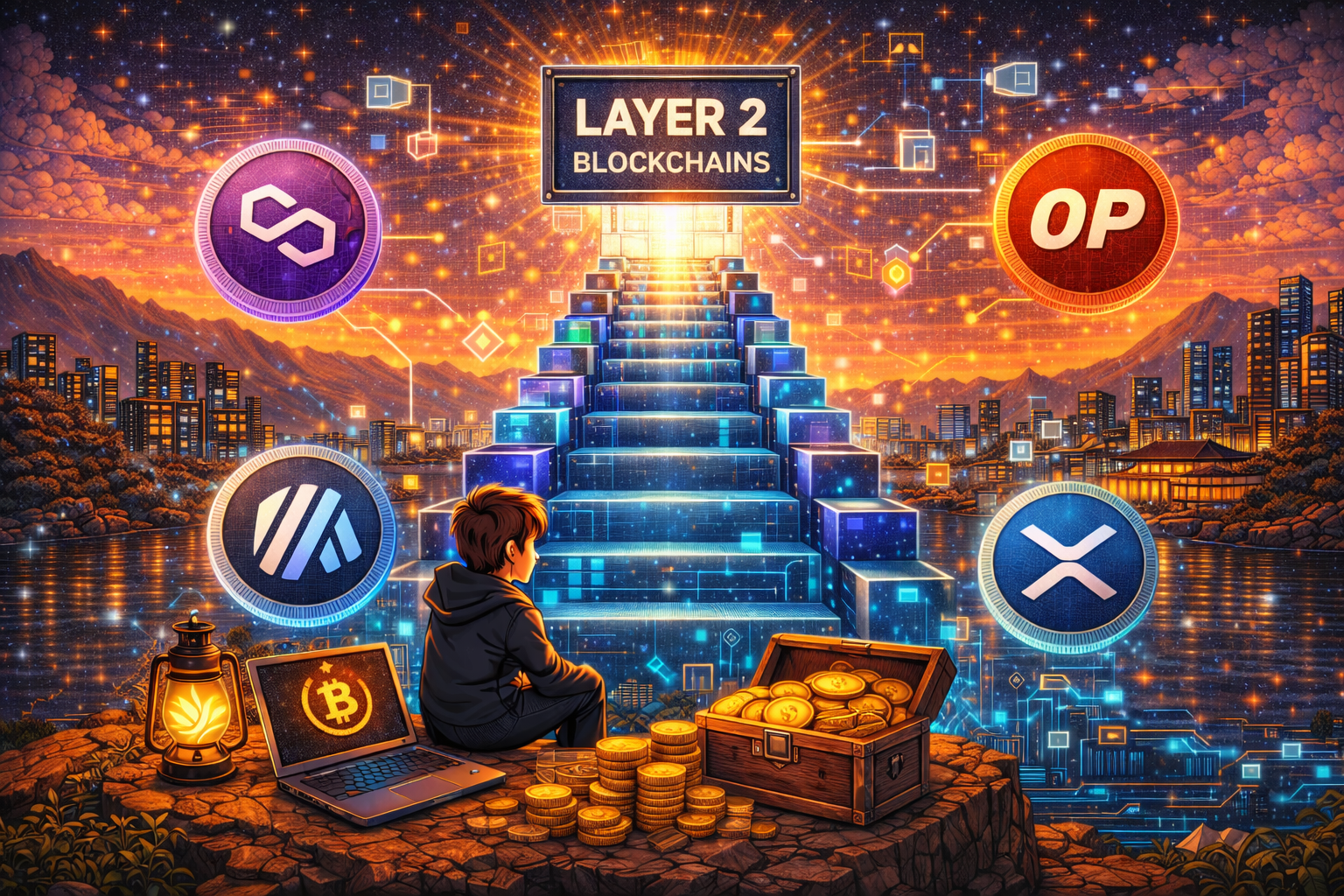

Ethereum’s base layer processes ~15-30 transactions per second: inadequate for global usage. Layer 2 solutions increase throughput while inheriting Ethereum’s security. Understanding tradeoffs helps you choose appropriate infrastructure.
How Each Approach Works Technically
Optimistic Rollups (Arbitrum, Optimism): Execute transactions off-chain, post transaction data to Ethereum, assume validity unless challenged. 7-day withdrawal delay allows fraud-proof submission. Trust model: one honest verifier can catch fraud.
ZK-Rollups (zkSync, StarkNet): Generate zero-knowledge proofs that transaction batches are valid without revealing details. Post proofs to Ethereum for verification. Withdrawals are immediate because mathematical proof guarantees validity.
Sidechains (Polygon PoS): Independent blockchains with own consensus, periodically checkpoint to Ethereum. Faster but rely on separate validator sets, sacrificing Ethereum’s security guarantees.
Security Tradeoffs: What Are You Giving Up?
Optimistic Rollups: Inherit Ethereum security if at least one honest verifier exists. 7-day withdrawal delay protects against fraud but inconveniences users. Data availability on Ethereum ensures anyone can reconstruct state.
ZK-Rollups: Cryptographic proofs provide immediate finality with Ethereum-level security. Complexity means fewer teams can audit code. Prover centralization possible if generating proofs requires expensive hardware.
Sidechains: Security depends entirely on sidechain validators. If they collude or get hacked, funds are at risk despite Ethereum remaining secure. You’re trusting different consensus mechanism.
Speed and Cost Comparisons
Transaction Speed:
- Ethereum L1: 15-30 TPS, 12-15 second block time
- Optimistic Rollups: 2,000-4,000 TPS, instant soft confirmation
- ZK-Rollups: 2,000-5,000+ TPS, instant finality with proof
- Sidechains: 7,000+ TPS depending on design
Transaction Costs:
- Ethereum L1: $5-50+ during congestion
- Optimistic Rollups: $0.10-2 typically
- ZK-Rollups: $0.05-1 typically
- Sidechains: $0.01-0.10 typically
Withdrawal Times:
- Optimistic: 7 days to L1 (instant L2-to-L2)
- ZK: Minutes to L1 once proof generated
- Sidechains: Depends on bridge design, typically minutes-hours
When to Use L2 vs Staying on L1
Use Ethereum L1 for:
- Large value transfers where security premium justifies higher fees
- Maximum decentralization and censorship resistance
- DeFi protocols where composability with other L1 protocols matters
- NFTs requiring maximum security and permanence
Use Optimistic Rollups for:
- DeFi applications needing EVM compatibility
- When 7-day withdrawal acceptable
- Applications requiring lower fees than L1 but more security than sidechains
Use ZK-Rollups for:
- Payments requiring instant finality
- Privacy-sensitive applications
- When fast L1 withdrawals important
- Maximum security at lowest cost
Use Sidechains for:
- Gaming requiring ultra-low latency
- Applications where slight security reduction acceptable for massive cost savings
- Experimentation with features incompatible with Ethereum
The Future: Will L1s Even Matter?
Ethereum’s roadmap (The Surge) targets 100,000+ TPS across L2 ecosystem. If successful, most activity moves to L2, with L1 serving as settlement layer. This “rollup-centric roadmap” positions Ethereum as security foundation rather than execution environment.
Competing L1s (Solana, Avalanche) argue monolithic chains providing high performance without complexity of L2s will win. The debate: Is security-first approach with L2 complexity better than integrated high-performance L1?
Crypto’s Energy Future: Separating Facts from FUD in the Climate Debate
Bitcoin mining consumed significant energy in 2025, yet over 52% now runs on sustainable sources. Understanding actual data versus environmental FUD is essential for evaluating crypto’s climate impact.
Actual Energy Consumption Data
Bitcoin: Current global energy consumption approximately 150-200 TWh annually, comparable to Argentina or Netherlands. Current Bitcoin hashrate is 1.032 ZH/s consuming massive electricity.
Ethereum Post-Merge: Transition to proof-of-stake reduced energy consumption 99.95%, from ~100 TWh to ~0.01 TWh annually. Demonstrates dramatic efficiency gains possible through consensus mechanism changes.
Other Chains: Proof-of-stake networks (Cardano, Solana, Avalanche) consume negligible energy relative to proof-of-work chains.
Renewable Energy Adoption in Mining
Approximately 40-52% of Bitcoin mining powered by renewable energy as of 2025. Geographic distribution: Iceland (geothermal), Quebec (hydropower), Texas (wind/solar), Nordic countries (hydropower/wind).
Economic incentives drive this trend: renewable energy often cheaper than fossil fuels, especially in regions with surplus capacity. Miners are hypersensitive to electricity costs, naturally gravitating toward cheapest sources.
Comparison to Traditional Finance and Other Industries
Bitcoin vs Banking System: Traditional banking infrastructure (branches, ATMs, data centers, employee commutes) estimated 260+ TWh annually. Bitcoin’s 150-200 TWh looks different in context.
Bitcoin vs Gold Mining: Gold mining consumes ~240 TWh annually, produces toxic waste, and causes environmental destruction. Bitcoin has no physical environmental footprint beyond energy.
Bitcoin vs Gaming Industry: Gaming hardware and data centers consume ~100-120 TWh annually: comparable to Bitcoin but receives little criticism.
Bitcoin vs AI/Data Centers: AI now consumes more power than Bitcoin mining in 2024, using water equivalent to global annual bottled water consumption.
Grid Stabilization Benefits
Flexible mining load provides grid services traditional consumers can’t. During Texas December 2022 blizzard, Bitcoin miners returned up to 1,500 MW to grid, enough to heat 1.5 million homes. This demonstrates crypto mining’s unique ability to instantly curtail demand during emergencies.
Renewable energy intermittency creates challenges: solar produces maximum power midday when demand low, wind generates most at night. Bitcoin miners can consume surplus renewable energy that would otherwise be curtailed, improving renewable project economics.
Future Innovations
Heat Recycling: Some miners capture waste heat for district heating, greenhouses, or industrial processes. Turns “waste” into useful byproduct.
Stranded Energy: Remote renewable installations can mine Bitcoin before grid infrastructure built, funding construction that wouldn’t otherwise be economically viable.
Emissions-Free Proof-of-Work: Researchers explore using excess renewable capacity exclusively, creating emissions-free proof-of-work consensus.
The energy debate isn’t binary. Bitcoin consumes significant energy, but context matters: increasing renewable percentage, grid stabilization value, comparison to alternative systems, and evolving efficiency. Proof-of-stake alternatives demonstrate dramatic energy reduction is possible for chains willing to make tradeoffs. The real question: What activities justify consuming resources, and who decides?
Let’s Connect:
Follow us on X: https://x.com/OnchainNewsBlog
Join our Telegram channel: https://t.me/onchainnewsblog
Subscribe to our newsletter: https://onchainnews.blog/newsletter-alpha/
Disclaimer
The information provided in this article is for informational and educational purposes only and should not be construed as financial, investment, or trading advice. Onchain News does not provide recommendations to buy, sell, or hold any asset, and nothing here should be taken as a guarantee of future performance. Always conduct your own research and consult a qualified financial professional before making any investment decisions. Cryptocurrency markets are volatile and you are responsible for your own risk.
Common questions
What is the core difference between optimistic and ZK rollups? Optimistic rollups assume transactions are valid and allow a challenge window to dispute them. ZK rollups prove validity cryptographically up front. The first is simpler and slower to finalise; the second is harder to build and finalises faster.
Why does the challenge window matter? Because withdrawals to the Layer 1 wait for it, typically around a week. Third-party bridges offer faster exits by fronting liquidity, which reintroduces a trust assumption the rollup was designed to avoid.
Where do sidechains sit? Outside the rollup category. A sidechain has its own consensus and its own security, so it does not inherit the Layer 1’s guarantees at all. Calling it a Layer 2 blurs a real distinction.
Leave a Reply